
Trump Lashes Out at Xi Over Military Display, Accuses China of “Conspiring Against U.S.” Amid Growing Diplomatic Rift
By New Journalist Today | September 3, 2025
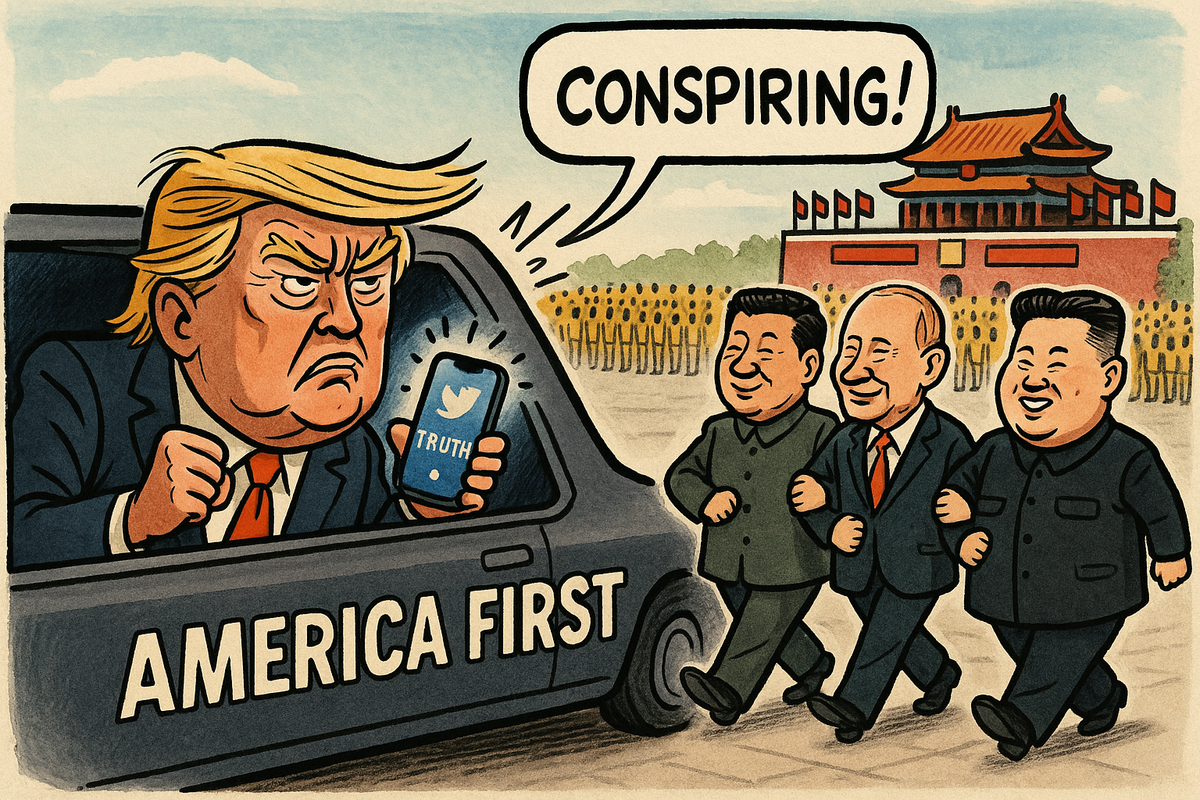
WASHINGTON — U.S. President Donald J. Trump launched a fiery rebuke on Tuesday following a massive military parade in Beijing where Chinese President Xi Jinping led a high-profile procession of troops and weapons alongside Russian President Vladimir Putin and North Korean leader Kim Jong Un.
The event, held to mark China’s Victory Day, drew 26 world leaders and was widely interpreted as a show of force — and a symbolic rejection of U.S. global dominance. Trump, writing on his Truth Social platform, accused the three authoritarian leaders of “conspiring against the United States of America,” while sarcastically sending his “warmest regards” to Putin and Kim.
In the same post, Trump referenced the American soldiers who died in China during World War II, arguing that their sacrifice helped China win its independence and deserved greater recognition.
“The big question to be answered is whether or not President Xi of China will mention the massive amount of support and ‘blood’ that The United States of America gave to China in order to help it to secure its FREEDOM from a very unfriendly foreign invader,” Trump wrote. “Many Americans died in China’s quest for Victory and Glory. I hope that they are rightfully Honored and Remembered for their Bravery and Sacrifice!”
“May President Xi and the wonderful people of China have a great and lasting day of celebration. Please give my warmest regards to Vladimir Putin, and Kim Jong Un, as you conspire against The United States of America.”
Though Trump’s post was characteristic in tone, its implications were anything but trivial. It marked a fresh escalation in the already tense U.S.-China relationship and raised broader questions about the efficacy of Trump’s foreign policy, especially his reliance on “personal diplomacy” with adversarial leaders.
Beijing Parade Sparks Strategic Alarm
Tuesday’s parade was more than just a patriotic celebration. Analysts across multiple global outlets said it represented a turning point in China’s campaign to build a new international coalition that challenges the postwar Western order.
According to BBC News, Xi used the event to call China “a great people who do not yield to violence,” underscoring Beijing’s ambition to be seen as a moral and geopolitical counterbalance to U.S. leadership.
Prior to the parade, China hosted a summit of the Shanghai Cooperation Organization (SCO), where Xi met with leaders from India, Turkey, and Iran — all nations that the U.S. has had frictions with under Trump’s “America First” doctrine. This shift, experts say, signals that China is seizing opportunities created by Washington’s strategic missteps.
In one particularly symbolic moment captured by The Guardian, Indian Prime Minister Narendra Modi was seen sharing an extended private conversation with Putin in the Russian president’s limousine. Modi’s presence at the parade, seated next to Xi and Putin, reflected a growing warmth between New Delhi and Beijing — and served as a visible strain on the U.S.-led Quad alliance.
Tariff Diplomacy Yields Diminishing Returns
Trump’s second term has been defined by aggressive tariffs and economic nationalism. But those same policies appear to be backfiring. As reported by CNN, China has retaliated by leveraging control over rare earth minerals — critical to U.S. military and tech sectors — while simultaneously forming economic bonds with countries that previously leaned toward Washington.
International relations scholar Jackie Wang told the BBC, “China is capitalizing on the United States’ strategic errors and actively preparing to build an alternative center of global power.”
Indeed, nations like India, Turkey, and Egypt — once courted as strategic partners by the U.S. — have increasingly leaned toward China’s more transactional and less ideologically demanding approach to diplomacy.
The Limits of Personal Diplomacy
Trump’s emphasis on cultivating personal relationships with autocratic leaders like Putin, Kim, and Xi has shown diminishing returns. Despite multiple summits, Putin has only escalated his aggression in Ukraine. Kim continues to expand his nuclear arsenal. And now, Xi is leading a parade of military might, flanked by America’s primary geopolitical rivals.
A report by CNN concludes that Trump’s strategy has “collapsed under the weight of complex global interests,” noting that “his handshake diplomacy cannot compete with China’s long-term geopolitical strategy.”
A Realignment in the Global Order?
Trump’s critics argue that his policies have not only alienated allies but inadvertently accelerated the formation of a global anti-U.S. bloc. While his base remains energized by his rhetoric of American strength and sovereignty, the world appears to be moving in a different direction.
Diplomatic analysts say we are witnessing the early stages of a “multipolar world,” in which the U.S. no longer dictates the rules. Instead, countries are increasingly hedging their bets, seeking security and opportunity in a new balance of power.
Domestic Backlash and Legal Defeats Mount
While Trump continues to project strength abroad, his domestic agenda is drawing fierce resistance. On September 2, a federal court ruled against his attempt to federalize the National Guard in California, calling it an unconstitutional overreach of executive power.
The ruling came after California Governor Gavin Newsom filed a lawsuit challenging Trump’s plan to deploy federal troops in Los Angeles and Chicago. Newsom hailed the decision as “a necessary check on presidential overreach.”
Meanwhile, Trump’s plans for the largest immigration enforcement operation in U.S. history — including hiring 10,000 ICE agents and 3,000 CBP officers — has sparked alarm among civil rights advocates. As The Guardian reports, shortened training timelines and lowered recruitment standards risk enabling the infiltration of far-right extremists into federal law enforcement.
South Korea Dispatched High-Level Delegation to Beijing
While tensions flared between Washington and Beijing, South Korea maintained a parallel track of diplomatic engagement. Woo Won-shik, the Speaker of the National Assembly, had visited China from September 2 to 5 upon the official invitation of the Chinese government to attend the Victory Day ceremony in Beijing.
During his visit, Speaker Woo sought to promote a more mature development of the “strategic cooperative partnership” between South Korea and China. His agenda focused on reviving parliamentary diplomacy and restoring channels for cultural and human exchanges that had withered in recent years.
He also reportedly extended an invitation to President Xi Jinping to attend the upcoming APEC Summit in Gyeongju and conveyed the concerns of Korean businesses operating in China. Additionally, Woo raised issues surrounding the preservation of Korean independence movement sites and called for China’s constructive role in supporting peace on the Korean Peninsula.
The speaker’s delegation included lawmakers Park Jie-won, Kim Tae-nyeon, Park Jeung, Hong Kee-won, and Kim Joon-hyung, along with Chief of Staff Cho O-sup — all members of the Korea-China Parliamentary Friendship Association, noted for their deep expertise in bilateral relations.
Q & A: What You Need to Know
Q1: Why did Trump target Xi Jinping with such a public rebuke?
A1: Trump viewed the Beijing military parade as a direct geopolitical provocation and a symbol of an emerging anti-American alliance, prompting his response.
Q2: Why is Trump’s foreign policy under fire?
A2: Despite prioritizing personal diplomacy, Trump has seen no progress in curbing Russian aggression or North Korea’s nuclear ambitions, while trade tensions with China have intensified.
Q3: Why is India leaning closer to China?
A3: Modi's government has grown wary of Trump’s erratic trade policies and protectionist measures, while China has offered India greater economic cooperation and diplomatic respect.
Q4: What kind of pushback is Trump facing at home?
A4: A federal court ruled against Trump’s deployment of federal troops in states like California, declaring it unconstitutional. State leaders have accused Trump of abusing his authority.
Q5: What’s happening with immigration enforcement?
A5: Trump’s plan for mass recruitment at ICE and CBP has drawn criticism over the potential influx of unvetted agents with extreme ideological leanings.
Q6: How is global diplomacy shifting?
A6: The U.S.-led liberal order is weakening, while China spearheads a growing coalition of nations seeking a new balance of power. Trump’s isolationist policies may be hastening this transition.